What Should Nigerian Poultry Farmers Consider Before Buying an H-Type Layer Cage System?
What Should Nigerian Poultry Farmers Consider Before Buying an H-Type Layer Cage System?
For a commercial poultry farmer in Nigeria, choosing an H-Type layer cage system is not simply a question of finding the lowest cage price. The total investment depends on the farm capacity, cage configuration, poultry house dimensions, automation level, transportation and the equipment included in the quotation.
This is particularly important for farmers planning medium- and large-scale layer farms, such as 30,000, 50,000 or 100,000 birds.
What Determines the Cost of an H-Type Layer Cage in Nigeria?
Several factors can change the final cost of an H-Type layer cage project.
1. Farm Capacity
The first factor is the number of layers the farm is designed to accommodate.
A 20,000-layer farm will naturally require fewer cage sets and less automation than a 50,000- or 100,000-layer project.
For example, a commercial buyer planning 50,000 layers should calculate the required cage quantity according to the selected cage model rather than simply multiplying a single cage price by an estimated number.
The cage capacity per set, number of tiers and final house layout all affect the calculation.
2. Cage Configuration
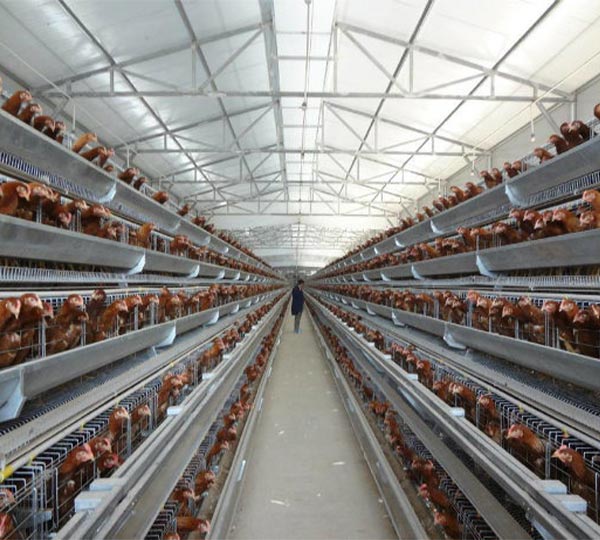
Not every H-Type cage system has the same configuration.
Buyers should check:
-
Number of tiers
-
Birds per cage set
-
Cage dimensions
-
Number of doors
-
Galvanization and steel material
-
Feeding trough design
-
Nipple drinking system
-
Manure removal method
-
Egg collection method
A quotation that appears cheaper may simply include fewer components.
For this reason, comparing the equipment list is more useful than comparing only the total price.
H-Type Cage Cost Should Be Compared as a Complete System
An H-Type layer cage system is normally connected with several automatic poultry equipment systems.
A commercial project may include:
-
H-Type layer cages
-
Automatic feeding system
-
Nipple drinking system
-
Automatic manure removal
-
Automatic egg collection
-
Feed silo and feed conveying
-
Ventilation fans
-
Cooling pads
-
Environmental control
-
Lighting
-
Electrical control system
-
Spare parts and installation support
This means that two suppliers can provide very different quotations for what appears to be the same “H-Type layer cage.”
One supplier may quote only the cage body, while another quotation may include feeding, manure removal, egg collection and environmental control.
When comparing suppliers in Nigeria, buyers should therefore ask for a detailed equipment list.
How Many H-Type Cage Sets Are Needed?
The cage quantity should be calculated from the planned farm capacity and the capacity of the selected cage model.
For example, if a selected 4-tier H-Type cage accommodates approximately 192 birds per set, a preliminary calculation for a 50,000-layer project would be:
50,000 ÷ 192 ≈ 261 cage sets
This is only a preliminary calculation.
The actual quantity can change after the supplier checks:
-
Poultry house length
-
Poultry house width
-
Aisle width
-
Cage row arrangement
-
House columns
-
Equipment configuration
-
Working space
-
Future expansion requirements
Therefore, the correct approach is to design the cage layout first and then confirm the final equipment quantity.
What About a 50,000-Layer Farm in Nigeria?
A 50,000-layer farm is large enough that automation can have a significant effect on the overall project design.
For this type of project, the buyer should consider more than the cage itself.
A typical planning process would include:
Step 1: Confirm the target capacity
Determine whether the farm will accommodate 30,000, 50,000, 80,000 or 100,000 layers.
Step 2: Select the cage system
Choose the number of tiers and birds per cage set according to the project requirements.
Step 3: Prepare the poultry house layout
The cage rows, aisles, manure removal system and egg collection direction should be considered together.
Step 4: Select the automation level
Decide whether feeding, manure removal and egg collection will be manual, semi-automatic or fully automatic.
Step 5: Calculate the complete equipment requirement
Only after these factors are confirmed can the supplier prepare a more meaningful project quotation.
Should Nigerian Farmers Choose H-Type or A-Type Cages?
This depends on the farm’s operating requirements rather than simply the cage price.
H-Type systems are generally considered for commercial farms where higher stocking density and greater automation are important. Their multi-tier structure can make better use of the available poultry house space.
A-Type systems can be considered for smaller or more budget-conscious farms where a simpler management system is preferred.
For example, a farmer planning a 10,000-layer farm may have different priorities from an investor planning a 100,000-layer commercial operation.
The important question is therefore not:
“Which cage is cheaper?”
A better question is:
“Which cage system fits my capacity, house design, labor availability and automation requirements?”
What Should Be Included in a Nigeria H-Type Cage Quotation?
Before placing an order, Nigerian buyers should ask the supplier to clarify the following information:
| Item | What to Check |
|---|---|
| Cage model | Tiers, dimensions and birds per set |
| Cage quantity | Total sets required |
| Feeding | Manual, semi-automatic or automatic |
| Drinking | Nipple quantity and water system |
| Manure removal | Scraper, belt or other system |
| Egg collection | Manual or automatic |
| Ventilation | Fans and cooling equipment |
| Control system | Electrical and environmental controls |
| Spare parts | Included quantity and components |
| Installation | Included or excluded |
| Packing | Export packing method |
| Shipping | Port or destination quotation |
This checklist can prevent misunderstandings when comparing different poultry equipment suppliers.
Why Poultry House Dimensions Matter
The poultry house should not be treated as a separate issue from the cage system.
For an existing building, the supplier needs to know the usable length, width and height. Column locations can also affect cage row positioning.
For a new poultry house, it is usually better to confirm the preliminary cage layout before finalizing the building dimensions.
This can help avoid problems such as:
-
Insufficient aisle space
-
Incorrect row length
-
Difficult manure removal
-
Poor egg collection layout
-
Insufficient ventilation space
-
Limited room for future expansion
A good quotation should therefore be based on the relationship between the cage system and the poultry house rather than on the cage price alone.
What Information Should You Send to a Supplier?
If you want an H-Type layer cage quotation for a Nigerian farm, prepare the following information:
Bird type: Layers
Farm capacity: For example, 30,000 / 50,000 / 100,000 birds
Poultry house size: Length × width × height
House status: Existing or planned
Automation: Feeding / drinking / manure removal / egg collection
Location: Nigeria + destination city or nearest port
Expansion plan: Current capacity and future capacity
Providing this information allows the supplier to calculate the cage quantity, layout and equipment requirements more accurately.
Final Considerations
The cost of an H-Type layer cage in Nigeria should be evaluated as part of the entire poultry equipment project.
A low cage price does not necessarily mean a lower total investment if important equipment is excluded from the quotation. Likewise, a higher quotation may include automation, environmental equipment, installation support or other components that another supplier has excluded.
For Nigerian poultry farmers, the most useful starting point is therefore to determine the farm capacity, poultry house dimensions and required automation level before comparing quotations.
For a detailed breakdown of H-Type cage pricing, equipment scope and a 50,000-layer planning example, see this guide to H-Type layer cage cost in Nigeria.
You may like:
 Livi Machinery Revolutionizes Poultry Farming: A Case Study with a Nigerian Farmer
 What Equipment Do You Need for a 10,000-Layer Farm in Nigeria?
 Elevate Your Poultry Farming Efficiency with Affordable Battery Cages for Layers in Nigeria
 Livi Machinery: High-Quality Automated Ground-Based Poultry Equipment Now Available in Nigeria